


Soil Health and Healthy Trees: What Your Ballarat Garden Actually Needs

One of the most common things we hear at the nursery is "I've planted my tree and I'm giving it Seasol, so it should be right." And look, Seasol is a great product and one we regularly recommend. But it is not a fertiliser, and understanding that difference is probably the single most important thing you can do for a newly planted tree.
Think of it like this: as humans we might take vitamins to support our health, but we still need food. Imagine having nothing to eat but being given a vitamin tablet every day instead. You wouldn't feel great for very long. Your trees are much the same.
Soil conditioners like Seasol are the vitamins. Fertiliser is the food. Good soil health is what allows your tree to make use of both. Get all three working together and your trees will show it.

Good soil health starts with understanding Ballarat clay
Here around Ballarat, one of the biggest challenges we deal with is heavy clay soil. And it's worth saying upfront: clay itself is not necessarily bad. It can hold plenty of moisture and nutrients. The problem is when it becomes heavily compacted and water and air can no longer move through it properly.
Tree roots need oxygen just as much as water. If the ground stays waterlogged and airless, roots struggle to establish and nutrient uptake slows. So even if the nutrition is there on paper, the tree can't access it.
This is why simply adding more fertiliser when your tree is looking sad is not always the answer. Sometimes the nutrients are already there. The tree just can't get to them.
Not sure if your soil structure is the problem? Put two tablespoons of soil into a glass of water, give it a stir and wait ten minutes. If the water stays cloudy and the soil doesn't settle, your clay structure needs attention. If it clears, you're in better shape than you think.

Gypsum vs lime: which one does your soil actually need
This is where a lot of gardeners get tripped up. Gypsum and lime are not the same thing and reaching for the wrong one can cause more problems than it solves.
Lime raises soil pH. If your soil is too acidic and your plants need more alkaline conditions, lime is the right tool. Gypsum doesn't touch pH at all.
What it does is break down the physical structure of heavy clay, improving drainage and allowing water and air to move through the ground properly. It supplies calcium and sulphur, helps bind clay particles into larger aggregates and unlocks nutrients already sitting in your soil by giving roots somewhere to actually go.
So if you've had a soil test and pH is the issue, that's a lime conversation. If your soil structure is the problem (waterlogging, compaction, slow drainage) that's when gypsum earns its place. For most Ballarat clay soils, it's the structure that needs work first.
Gypsum can also help in sodium-affected soils, which becomes relevant when irrigating with bore or dam water over time. Excess sodium damages clay structure, leaving soil sticky when wet and rock hard when dry. The calcium in gypsum gradually displaces that sodium, improving conditions with adequate water and drainage.
Gypsum is not an overnight fix. It works through the soil with rainfall and irrigation over months. For Ballarat conditions, autumn is the best time to apply it.
Winter rain does a lot of the work for you, gradually moving the gypsum down through the soil profile so it's already doing its job by the time spring arrives. Early spring works too if you've missed the autumn window.

Why adding compost and organic matter does more than you think
Most people think of soil as just dirt. Something to plant into. But healthy soil is alive, and that changes everything.
Underneath the surface there are microbes, fungi and earthworms working constantly. They break down organic material, earthworms physically open up the ground so air and water can move through it, and together they convert what's in your soil into something plant roots can actually use.
Take that biology away and the soil stops doing its job, no matter what you put on top of it.
Something that surprises most people when we mention it is plants don't just sit there waiting to be fed. They actively push compounds down through their roots to attract specific bacteria and fungi, which then mine minerals from the surrounding ground and pass them back up to the plant.
If you’ve got no soil biology, it means no mining crew. The nutrients might be there, but the plant can't get to them.
This is why we recommend products like Permafert at planting time. It's a soil conditioner, not a fertiliser, and mixed into the backfill around a fifth of a bag per advanced tree it adds organic matter and gets that microbial activity going.
Compost and well-aged manure do the same job. Fresh manure needs at least twelve months to break down before it goes anywhere near your trees.
For compacted ground, Lucerne hay is worth knowing about. It's high in nitrogen and as it breaks down it physically opens up pathways through the soil, which helps water reach the root ball where it's needed.

How and when to fertilise your trees
Once the soil structure is sorted, fertiliser has something to work with.
For most non-native trees, a balanced slow-release fertiliser applied in early spring is all you need. Apply it around the drip line (the outer edge of the canopy, not up against the trunk), once a year and let it do its job across the growing season. The 12 to 14 month products are ideal for this: one application, consistent release, job done.
For Australian natives, use a low-phosphorus fertiliser. Many have evolved in phosphorus-poor soils and genuinely struggle with high-phosphorus products. It is one of the most common mistakes we see and it's an easy one to avoid if you know to ask.
And don't over-fertilise. More is not better. Too much nitrogen pushes fast, soft, leafy growth that's vulnerable to wind damage and pest pressure, and Ballarat conditions are hard enough on young trees without adding that to the mix.
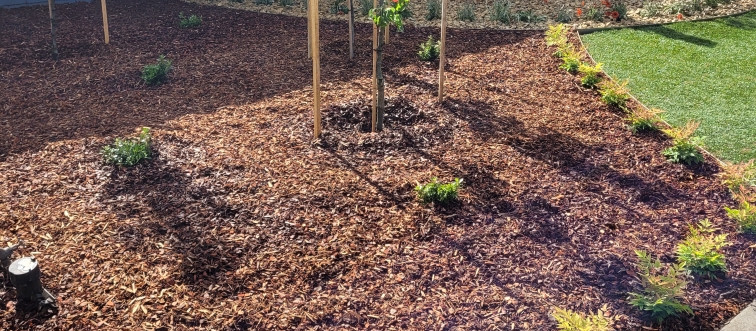
Mulch is also worth mentioning here. A good layer of sugar cane mulch at 5 to 7cm regulates soil temperature, holds moisture and slowly feeds the soil as it breaks down. Keep it a hand's width away from the trunk. One of the simplest things you can do.
So where does Seasol actually fit?
We started talking about Seasol so it's worth finishing there too. It does a genuine job, just not the one most people think.
Seasol is a soil conditioner and plant tonic. It stimulates root growth, reduces transplant shock and helps trees cope when conditions get tough Perhaps it’s that unusually hot week in January or the stress of being moved from a pot into the ground.
We recommend using it at planting time and through periods of environmental stress for exactly those reasons.
What it doesn't do is feed the plant. That's fertiliser's job. And neither Seasol nor fertiliser can compensate for soil that isn't structurally sound enough to let roots grow through it.
Get the soil right first, feed the tree properly and then Seasol does exactly what it's designed to do.

Not sure what your soil actually needs? Come and talk to us.
Soil structure, organic matter and the right fertiliser at the right time. Each one matters on its own but together they make a real difference to how your trees grow in Ballarat's conditions.
We stock a wide range of gypsum, slow-release fertilisers, organic mulches and soil conditioners, but not every garden needs every product.
Come and talk to us about your soil, what you're growing and how you're watering. Our qualified horticulturists can work out what your trees actually need rather than having you spend money on things they don't.
Book a nursery appointment at ballaratnursery.com


Comments